Wednesday, June 8, 2011

The Origins of Competition Aerobatics

What was originally going to be a blog on competition aerobatics has become a recounting of the origins of competition aerobatics and the natural progression of flying an aircraft in an attitude other than straight and level.

Believe it or not we are going to start with the Wright brothers' maiden flight of the Wright Flyer I on December 17, 1903. The interesting fact is, it wasn't until September 20, 1904 that the first 360 degree turn was completed. Trust me, it was attempted many times before, but without success and unscathed airframes. Without going into great detail to maintain interest, what was happening is, as the aircraft banked, the nose would rise and the aircraft would fall out of the sky. It was the Wright brothers who first coined the term "stall" referring to the loss of lift from the wings. Unfortunately they created quite a bit of confusion which still lingers today. They associated the stall with a loss of airspeed rather than an increase in angle of attack.

So how does this relate to competition aerobatics you ask. Well, over the next few years, the Wright brothers were invited to give flying demonstrations all over the US and Europe. These events would be some of the largest gatherings of people with much pomp and circumstance . Headlines heralded these great events of amazing machines and the daring pilots who flew them. After a while there became other flying machines other than the Wright Brothers' and these aerial displays became more of a contest pitting one aircraft design against another. Now we need to consider that up until 1910, a steep turn was considered quite dangerous.

It was at this time that Walter Brookins, who was one of the first pilots the Wright brothers' recruited to fly the Wright Flyer at these different meets, that got things progressing . To help create some distinction, apart for the competition, Brookins started to incorporate the "Death Spiral" along with numerous steep turns during his display. Newspapers ate this up and wrote wild accounts of his feats. Needless to say this did not go unnoticed by the other pilots and aircraft manufactures. Competition created a need for stronger, faster, and more maneuverable aircraft and pilots who could push these aircraft to the very boundaries of flight.

One of the things I enjoy teaching is "Spin Recovery" even today, there is much misinformation about spins and therefore an appreciable fear of them with most pilots. The term "Spin" did not enter the aviation vocabulary until WWI, so accounts before WWI of spins are rather vague. The first survivable spin is credited to Fred Raynham, an Avro test pilot in 1911. But there is some dispute as to whether he was in an actual autorotation or not. A more significant account of the first spin recovery is accredited to LT. Wilfred Park in 1912 in an Avro G cabin biplane. Not only was the event witnessed but Lt. Park was able to recount his recovery inputs. His account and procedure would be documented in many prominent aviation journals around the world.

Then a pivotal moment happened in the history of aerobatics. The birth of aerobatics occurred on September 9th, 1913 when Nikolaevich Nesterov of the Imperial Russian Air Service performs the first complete loop near Kiev in his Nieuport IV monoplane. This moment is so significant that the Nesterov Cup is awarded to the winning Team of the World Aerobatic Championships.

In 1914 Maurice Chevillard, in a Henri Farman biplane, accomplishes the first complete roll in an aircraft. An interesting note is Chevillard is actually credited for a maneuver that is named after Max Immelmann, a half loop up followed by a half roll. It would have been impossible for Immelmann to have performed this maneuver in the aircraft he was flying during the war.

So now we have the basis for all aerobatic maneuvers, The Spin, the Loop, and the Roll. All aerobatic figures are based on these three figures. Cool stuff! I know!

Up until now most aerial demonstrations were mainly aircraft designers and manufactures showing off their wares. But Lincoln Beachy, in the US, had an aircraft custom built to his specification by Glenn Curtiss. The resulting aircraft was a smaller than standard Curtiss biplane with a 100 h.p. Curtiss OX engine. Beach was credited as the first to perform a complete loop in the US and became a master of the looping figure. He became rich performing before huge gatherings. By the end of 1914 he has accounted for looping his aircraft more than a 1,000 times before more than 17 million people in over 126 cities. He charged the organizers $500 for the first loop and $200 for each additional loop. Beach had opened up the skies for all future air show performers to follow his lead.

After WWI, informal aerobatic competitions became a popular feature at air shows and air displays throughout Europe and the US. One German pilot stood out from the rest at these events. Gerhard Fieseler approached the practice of aerobatics in an extremely methodical way while inventing figures that are still used in competitive aerobatics contests today. The first contest I went to as a volunteer, I witnessed a maneuver that got me hooked on competitive aerobatics. It was a Rolling Circle, a 360 degree turn with 4 complete and blended rolls incorporated without varying altitude. Gerhard Fieseler invented and completed the first Rolling Circle in 1925 to win the German Aerobatic Championship.

From 1925 to 1927, pilots and aircraft designers all over the world were risking everything to be the first to perform the first Outside Loop. It was on May 25th, 1927 that Jimmy Doolittle in a Curtiss P-1B at the McCool Airfield in Dayton, OH performs the first outside loop!

In 1927, the first international aerobatic contest is held in Zurich. Gerhard Fieseler and 30 other competitors from countries including Germany, Czechoslovakia, France, Italy, Poland, Yugoslavia, and Switzerland. Although Fieseler was the clear winner, politics of an international panel of judges, prove otherwise and due to the politics of the day, and Fieseler being a German Pilot, Fieseler places second.

Fieseler goes on to start his own aircraft company and develops the Tiger F-2 with a symmetrical airfoil. The Tiger F-2 was very sensitive in all three axis, while keeping the mass of the engine, pilot and fuel in one general location. It also incorporated an inverted fuel and oil system. The Tiger F-2 becomes the first truly aerobatic aircraft.

In 1934, the first World Cup Aerobatic Championship was held in Paris hosting six nations. Fieseler comes out of retirement to compete and is crowned the First World Aerobatic Champion in History.

Friday, May 13, 2011

The Incredible Yak-52


The first aircraft to be featured in Flight Review is the incredible Russian built Yak-52. The Yak 52 is quite imposing as you walk around it on the ramp, after all the vertical stabilizer stands nearly nine feet above the ramp. The Yak stands tall on its landing gear in order to support its huge 360 h.p. supercharged nine cylinder radial engine and a mammoth 94 inch constant speed propeller. Taxiing, this lumbering giant lopes along sounding like the grand daddy of all Harleys. But perhaps the most beautiful attributes of the Yak-52, to the bystander, is the sound of its radial engine as it flies overhead.


The Yak-52 was designed to replace the aging Russian military trainers of the time. It was based on the single seat Yak 50 which was, at that time, a world champion aerobatic mount for Russia. The Yak-52 first took flight in 1976 and went into production in 1979 and ran till around 1999 with somewhere around 1800 Yak-52s being built. The Yak-52 filled multiple roles for Russia. It was used as a primary trainer, an instrument trainer, and aerobatic trainer, and was used to aid in transitioning into jets.


The Yak-52 is an all metal, two seat tandem military trainer that was built like a tank. Yet, as large as it appears, it is relatively light with an empty weight of only 2200 lbs. The cockpit is definitely a military cockpit that is laid out using some of the same instruments and equipment as the Mig-17 and Mig-21. The control stick is quite large and the rudder pedals are on a swing bar. The instruments are laid out in an efficient manner that is easy to adapt to. Besides the large radial engine up front, there are several unique traits the Yak-52 has that sets it apart from most modern Western aircraft. One of these traits, would be the extensive use of pneumatics throughout the systems of the Yak. The starter, brakes, flaps, and gear are all pneumatically operated. Oh, and the prop turns in the opposite direction too. So I am sure the Russian flight instructors were well versed in shouting LEFT RUDDER!!! (but in Russian)


I have been flying a highly modified Yak-52 known as "Bad Yak" at aerobatic competitions and air shows throughout the North West for the past five years and I absolutely love this aircraft. Bad Yak has had more than 240 lbs removed from its empty weight and it has 400 horse power hanging off its nose. It isn't the newest or the best aircraft made today, but it is unique, and we are a great match. You can't just pull a Yak out, walk around it, jump in and fire it up. It's a complex aircraft, systems have to be turned on, the prop pulled through a number of times to purge any oil that has accumulated in the cylinders. Then it's primed and then the prop is pulled through a few more times. Then you jump onto the wing, turn on a few more systems, climb in, prime some more, turn on a few more systems, then you get to fire it up. The Yak-52 looks like it came out of WW2 with its blunt round nose and rounded rudder. They say if a Yak isn't leaking oil, then it's out of oil. We prefer to say it's just marking its territory. But if you can start the Yak and get it taxied to the runway, it is a one of the easiest aircraft to take off and land. Anyone can land a Yak-52 and look like a pro.


My first experience flying the Yak-52 was like drinking from a fire hose. First of all, I was like a kid being allowed to sit in a fighter jet . Besides all the military style instruments, the control stick was huge, nearly chest high! Needing this much leverage, the aircraft had to be heavy on the controls, I thought. I had flown quite a few different aircraft but none as powerful and complex as the Yak. I could not believe the amount of acceleration nor the amount of left rudder required during the take off roll! Before I could get a handle on everything, we had blasted through pattern altitude. We went out to the practice area where I did a number of steep turns and was impressed how light the controls actually were. I then decided to do a series of Lazy Eights to get a feeling of the Yak at different airspeeds. I immediately became aware of the enormous amount of torque this aircraft produces and its effect at slower airspeeds. I then did a number of aileron rolls and remember laughing out loud. I had been used to rolling the Citabria which required both hands and a reasonable amount of strength and patience. The Yak required neither. Then we were going to do a loop. Bob talked me through it before, "180 mph, level wings and a give a good stiff pull, float over the top, then set the stick for rounding out the loop". So I dove a little to get the 180 mph, leveled off, hesitated a moment, then I yarded back on the stick... "Holy Crap!" As I was gaining some sense of awareness we were inverted and I was lost. I then brought the stick back a just a bit as we finished the loop. I started the loop headed South, and ended facing East, 90 degrees off heading. The huge amount of torque and me feeding in the wrong rudder caused us to fly almost a perfect quarter clover. Bob, the great sport he is, was laughing and told me to take a look at the G meter... I had pulled 7 Gs in probably what will be the smallest loop (quarter clover) that Yak has ever flown. I kept on muttering, "that's one big stick, that's one big stick". So as not to leave the ride like that, we did a couple, more gentle loops that left me happy.


Flying the Yak-52 is actually a pleasure. It has a nice harmony of controls which are well balanced. For me the Yak has the perfect amount of feel on the controls, not too light to be twitchy, and not too heavy to be numb. It is stressed to + 7 G and - 5 G and can perform any maneuver listed in the Aristi catalog, which is a list of all the maneuvers used in competition aerobatics from primary to unlimited. I have found the roll rate to be around 180 degrees a second. Having a non symmetrical wing, rolls require placing the nose a bit above the horizon when inverted to finish level. Stalls and spins are very predictable, in fact, I have found the Yak one of the easiest aircraft to consistently score well performing competition style spins. The Yak-52 has a Vne of 264 mph, higher than most modern aerobatic aircraft. At 180 mph the Yak-52 performs any looping or vertical figure with plenty of energy. The vertical line is very impressive, but has to be flown a bit to maintain.


Bad Yak has been modified to be more mission specific. With the increase in horse power and reduction in empty weight, we are able to achieve a max level airspeed of 195 mph, and a cruise of 170 mph. A sustained climb rate of 2750 feet per minute can be maintained to 3,000 feet. Below are some statistics for a stock Yak 52.


Yak-52 Stats

Length 25 ft 5 in

Wingspan 30 ft 6.25 in

Height 8 ft 10.5 in

empty weight 2200 lbs

Max T/O weight 2877 lbs

Powerplant Vedeneyev M14P 360 hp

Vne 264 mph

Max level Speed 177 mph

Cruise Speed 160 mph

Stall 55 mph

Service Ceiling 14,500 feet

Rate of Climb 1400 feet per minute

Monday, May 9, 2011

The Pilot's Watch

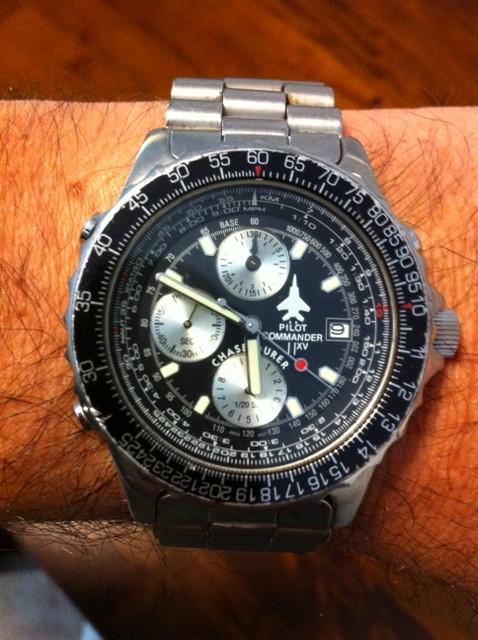
So what are the attributes that make up the perfect Pilot's Watch? The most important thing that a Pilot's Watch has to do, is announce to everyone else that the wearer of said watch is indeed a pilot. A good Pilot's Watch must be BIG! After all, billboards are big and therefore effective in conveying the desired message. So a BIG Pilot's Watch will tell everyone within 100 feet that a pilot is in the vicinity.

A pilots watch should have a big dial with large easy to read numbers and numerous smaller dials to perform various functions a pilot might require at one time or another. These kinds of watches are often referred to as a chronograph. Due to the numerous smaller dials, the watch has to have several buttons to push which, in turn, cause all the smaller dials to set into motion.

Last, but not least, a Pilot's Watch has to have a circular slide rule around it's bezel, referred to as an E6B. The E6B allows the pilot to calculate ground speed, fuel burn, estimated time of arrival, and other very important pilot stuff while on the fly.

Perhaps the quintessential Pilot's Watch is the Breitling Navitimer, one of the most coveted Pilot's Watch of them all. And for just one year of your child's college tuition, you too could one of these fine time pieces.

Now it may come across to you that I am making fun of Pilot's Watches, which I am. But I have to say, I personally love watches and have a drawer full of them. While I have a few "Pilot's Watches" I can also admit how silly some of these watches are when it comes to their functionality.

So let's get back to the task at hand and define those attributes that make the perfect Pilot's Watch. I believe the first trait mentioned before that a Pilot's Watch has to be BIG, is a valid trait. Perhaps this attribute serves a purpose other than announcing to everyone in the FBO that you are indeed a pilot. The younger pilots will be quick to quip an answer with," a larger pilots watch will be easier to read in turbulent conditions". But as we all know, the real reason a Pilot's Watch should be "Big" is, the people who can afford to fly "and" own a watch are over forty years old and probably has the words "must possess" on his or her medical.

The second attribute referring to a chronograph might be valid, but I would suggest that a digital chronograph might be more functional than an analog watch while being easier to read. I think one feature missing on most Pilot's Watches is a light for night flying. Most digital displays have a backlight which comes in handy on those night cross country trips.

The third attribute mentioned referring to an E6B on the bezel of the watch is in my opinion completely silly. First of all, who could possibly read the thing in the first place. And second, who has actually calculated a flight plan since they passed their check ride? With onboard GPS and web based flight planning programs, the E6B has almost become obsolete.

So let's look at some realistic attributes which would make the "Perfect Pilot's Watch". Here is what I have to offer. As much as I love analog watches, digital watches offer more functionality. The problem with hybrid analog/digital watches is, the analog hands always seem to be covering the digital display when you need it the most. So here is a check list for a useful pilots watch.

- Large Face

- Large easy to read numbers

- Multi Time Zone Function

- 24 hr Chronograph aka Stop Watch

- 24 hr Countdown Timer

- Both 12 and 24 hour Format

- Backlight or Long Lasting Luminous Markings

- Price that does not exceed the price of an annual or more preferably the cost of fueling up the aircraft with fuel

Sunday, May 8, 2011

Welcome To Flight Review


Welcome to Flight Review, we have my wife to thank for getting this thing started. So let's see if we can get this blog kicked off. This blog's title is going to be a bit of a play on words. Every pilot has to go through what is called a Flight Review every two years with a Flight Instructor, and as a Flight Instructor, I have given many Flight Reviews over the past decade. I have also been given the wonderful opportunity over the years to fly some pretty incredible aircraft. My goal is going to give a glimps into the life at the airport through the eyes of a Flight Instructor and Pilot.

To give you a little background, I have been a pilot for nearly fifteen years, and a Flight Instructor for over a decade. I personally fly a very unique aircraft, which is a Russian built Yak-52. The Yak-52 was designed as a rugged two seat trainer. It has a nine cylinder supercharged radial engine that produces over 400 horse power yet the aircraft weighs less than a Cessna 182. We have named this Yak "Bad Yak" and I fly it in Air Shows and Aerobatic Competition events through out the North West.

So throughout this blog, I hope to give some insight, thoughts and perspective of a pilot who is sometimes an educator, sometimes a showman, a father, a friend, and always an airport bum at heart. Noel